The majority of games are meant to be challenges, something to be overcome or figured out. The word “game” implies win and loss conditions, after all, or else it’s less of a “game” and more of an “activity.”
Of course, if there’s anything I love about the medium of
video games
, it’s that they can be divergent and deconstructive. A video game doesn’t necessarily need to stop and shame you whenever you do something allegedly incorrect.
Some games are designed to have their stories and progressions continue onward even if you’ve tackled a challenge incorrectly or made a less-than-ideal choice, albeit usually with some manner of story change or penalty. Some games don’t even have penalties, simply not progressing at all until you’ve done whatever it is you’re supposed to do.
In short, these are games that have no fail states. There are no game overs, retry screens, or any particular cut-to-black moment that stops the action when something happens that wasn’t supposed to. It can be tricky to pull off, but I’d say these are the games that did it best.
Return Of The Obra Dinn
We’ve Got All Night

Between having a magic watch that allows you to witness a person’s last living moments and being an insurance inspector, I’m not sure which scenario would give you more reason to be frighteningly dogged in your pursuits. I guess it doesn’t matter, because in
Return of the Obra Dinn
, you’ve got both excuses, which means we’re not going home any time soon.
Return of the Obra Dinn’s mystery-solving system is designed in such a way that you can’t really brute force it. You can’t, for instance, guess wrong and then just keep trying again until you guess right. The game won’t tell you if you’ve correctly deduced any fates until you get at least three right, and if your guesses are wrong, you’ll just have to leave them until you figure it out properly.
It is technically possible to bail on the Obra Dinn before you actually get any of the fates right, but that’s something you’d have to deliberately choose to do. In other words, that’s not a fail state, that’s a bad ending. Big difference.
The Stanley Parable
There Are No Wrong Answers

As that old saying goes, we may make choices, but it’s our choices that ultimately make us. That said, if your choices ended up getting you killed, you wouldn’t be able to make any more choices, which would be kind of lame for a game. This is why every choice in
The Stanley Parable
leads you on a continuous path
until you reach a proper ending
.
Choices are the central thematic crux around which The Stanley Parable revolves. You can choose to listen to the narrator, take the doors and paths he says, or just wander off into whatever random direction takes your fancy. The narrator will complain about it, sure, but that’s just another path for Stanley’s life to take.
Even choices that seem to end your path prematurely, such as walking off the cargo lift and splatting on the ground, are treated as full endings in themselves. It didn’t happen because you made a mistake, it happened because you made a mildly ill-informed decision. It’s not failing, it’s just… stopping. Messily.
Animal Crossing: New Horizons
You Can’t Fail At Being On Vacation

A large portion of simulator games, life simulators especially, are fairly light in fail states. You could technically fail in The Sims, for instance, if your whole Sims family dies or something. As the Animal Crossing games are generally even more laid-back than those kinds of games, death and failure aren’t even concepts worth mentioning. This is especially true in
New Horizons
.
The entire premise of New Horizons is that you’re on vacation, and at least as far as my sensibilities go, there’s no way to do a vacation wrong. You can spend your whole day pursuing tasks and chores, or you could just bum around and go fishing all day.
Granted, the latter won’t progress your island’s capabilities, but maybe you don’t care about that. It’s your vacation. You paid Nook to be here, and it’s your right to laze around if you’re so inclined.
The only thing even resembling a fail state in New Horizons is if you get stung by a scorpion or spider and pass out, but even then, you’ll just wake up shortly after, no worse for wear. You won’t even be sent home if you’re out on a Mystery Tour.
Journey
Places To Be
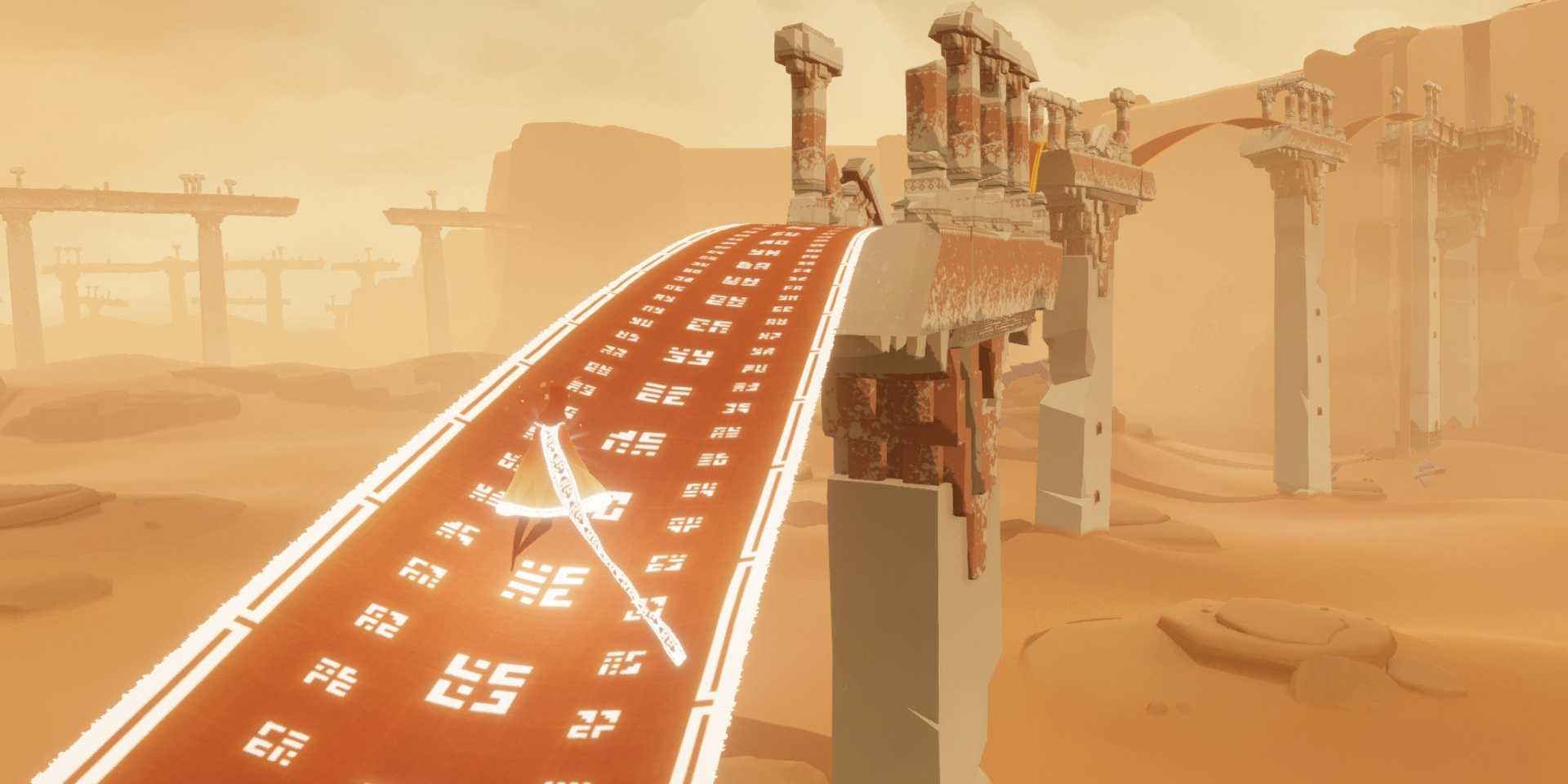
It’s a little difficult to make assumptions on
Journey
’s story because it has no dialogue, so I’m not completely sure if there’s a thematic reason this game has no fail states. If I were to hazard a guess, though, your little nomad person is just
really
determined to complete their journey, and absolutely nothing is going to stop them.
As Journey is a short, soulful experience through impressive visuals and wordless storytelling, having fail states wouldn’t really do the game any favors. It’s a game that wants to be seen, to be experienced, so there’s no real reason to hinder you in any meaningful way.
Falling off platforms just means you have to climb them again, getting attacked by enemies just tears off a little bit of your big, flowy scarf, and so on.
Journey is not a challenging or lengthy game, nor is it meant to be. If that’s a metaphor for something, I’m admittedly not sure what it is, but it does make it a very relaxing game to spend a few hours on.
Pyre
The Season Goes On

If you’re a fan of any particular sporting team, you know how seasons work. Even if your team loses a game, they’re not out of the running, the season just keeps going and they keep playing. Sports don’t have a retry button, and even sport-like ancient rituals like the ones in
Pyre
are much the same.
In Pyre’s story, the team of exiles you’re in command of, the Nightwings, are a special case against all others. They’re the ones to beat, the proverbial final boss for every other player. Because of this, even if you lose a Rite against one of the other teams, your position at the Final Rite of a cycle is still guaranteed. The only thing that tangibly changes is some character dialogue.
The more important distinction is in those Final Rites. Whoever wins this match gets to choose one of their exiles to send back to civilization, and if you lose, there are no do-overs. Either you get to send one of your band home, or the other team does. I got a good ending because I didn’t lose a single Final Rite, but just a few lost matches can change things severely.
Wanderstop
Healing Isn’t An Adventure

To paraphrase a cartoon therapist, repairing, maintaining, and cleaning are not an adventure; there’s no way to do it so wrong that you might die. Naturally, someone who spends their entire life in a constant ‘do-or-die’ state may find that difficult to come to terms with, but that’s more or less the central message behind Wanderstop.
At multiple points throughout her tenure as a tea shop worker, Alta asks Boro straight up to give her some kind of goal, something achievable that she can either pass or fail at in order to motivate herself to do it. Every time, Boro says that while there are plenty of tasks around the shop to do, there’s no real way to do them wrong.
Everything is at your own pace, and even if you do something incorrectly like make the wrong drink for a customer, you just do it again.
This framework is a deliberate decision that informs both Wanderstop’s gameplay and story. I admit, I found it jarring at first not to have any pressing objectives, and even kind of annoying to have my progress halted, but that’s just kind of life. It goes on.
Getting Over It With Bennett Foddy
You’ll Wish It Did Have Them

As he notes on his game’s Steam store page, Bennett Foddy made
Getting Over It
“for a certain kind of person, to hurt them.” Difficult games have been a thing forever, but even most difficult games have their small mercies like checkpoints and retries. Getting Over It does not have those, and that’s just part of how it’s precision-engineered to infuriate you.
Unlike other games with no fail states, Getting Over It’s lack of them doesn’t mean you can’t suffer setbacks. Rather, it means that you have to own every single setback you experience as part of a cohesive, linear experience. There are no fail states because you falling off a cliff and losing all your progress is just part of the game’s procedure.
I believe adding fail states to Getting Over It would muddle its
intentionally-infuriating design
, because if you could get a game over, you’d have a convenient excuse to stop playing. With this design, you don’t stop playing until you “get over it,” either by beating it or getting sick of it.
Coffee Talk
The World Doesn’t Stop For Coffee

When you’re having an exceptionally bad day, the smallest negative spark can feel like the end of the world. That’s why you see people blowing up at baristas at Starbucks. In the real world, though, life doesn’t stop just because you got the wrong coffee, and the same is true for a fantasy world like
Coffee Talk
’s.
Part of your duty as a faceless barista in Coffee Talk is to serve the drinks your customers ask for when they ask for them, as well as
providing a quiet, comfortable space for them to vent in
.
They won’t always give you clean-cut orders, though, and it is possible to get them wrong. In the early game, you might get a do-over, but for the most part, even if you get an order wrong, they’ll just go right on talking about whatever’s bugging them.
Of course, as I said, a small setback can have rippling consequences. You might just end up ruining that customer’s whole day by getting their order wrong, which can affect how cheery your ultimate ending will be.
Sam & Max Hit The Road
The Freelance Police Are Unflappable

Back in the golden age of point-and-click adventure games, there were two dominating design paradigms between Sierra and LucasArts. In Sierra games, you had to save constantly in order to avoid losing progress to sudden death.
In LucasArts games, there were no death
or fail states, just puzzles and shenanigans. I think one game that best illustrates the latter paradigm is that timeless classic, Sam & Max Hit the Road.
While a couple of LucasArts games have very mild fail states, there are none to be found in Hit the Road. If you get a puzzle solution wrong, just do it again. If you don’t have an item you need, just go somewhere else.
As a longtime fan of the Sam & Max franchise, I can say with confidence that a big part of their dynamic is that they’re borderline indestructible and consequence-free. They’re Freelance Police, and they can do whatever they want so long as they’re on a case. This is why, no matter how many ridiculous events and brutal injuries befall the two of them, they are never stopped or deterred.