
In our current digital landscape, there’s constantly a fresh gadget or platform claiming to revolutionize things. Recently, much of the buzz has been around AI-driven chatbots. Additionally, these AI technologies are positioning themselves as competitors to conventional search engines such as Google. Indeed, several AI firms have either introduced or declared their intentions to introduce alternative search platforms. For instance, certain ventures, including Perplexity’s initiative, aim to develop comprehensive AI-enhanced browsers for the internet.
Therefore, will we soon cease “Googling” and begin “chatting” with AI for information instead? To grasp what’s currently occurring, let’s examine the present scenario.
The Striking Ascendancy of AI Chatbots
Artificial intelligence chatbots have experienced significant growth recently and are anticipated to keep expanding quickly. By way of illustration, as of 2024, the chatbot industry had reached approximately $7.76 billion. It’s forecasted this number will grow by over 20% each year up to 2030. In terms of usage, visits to AI services surged by more than 250% within just the past year.
What’s fueling this significant expansion? A few key factors are at play. The underlying technology of chatbots has advanced considerably, enabling them to grasp our queries more effectively and deliver more relevant responses with a warmer, more relatable approach. Moreover, organizations have recognized that chatbots can enhance their customer support services. The “agentic” features of artificial intelligence assist businesses in boosting efficiency and reducing costs. Offering instant replies to customer inquiries around the clock? Artificial Intelligence makes that achievable.
Not only businesses but also users are growing fond of AI technology as it delivers swift, tailored responses efficiently. Many individuals prefer using chatbots over traditional search engines for specific activities. Moreover, indications suggest that the future advancement in AI chatbot development lies in enhancing user-specific learning capabilities. For instance, Google plans to enable Gemini to gain deeper insights into individual behaviors through an analysis of data from various associated platforms like Gmail and Photos. Consequently, this progress ensures that forthcoming interactions become progressively insightful, customized, and singularly relevant to every user.
Search Engines vs. Chatbots: Which Influences More Users?
Chatbots are extremely popular and their growth is accelerating quickly. Nonetheless, when it comes to online traffic, conventional search engines such as Google remain at the top of the heap. When comparing website traffic, search engines garnered significantly more visitors compared to chatbots over the past year. Actually, according to SEMrush statistics, search engines produced approximately 34 times as many visits as AI chatbots did.
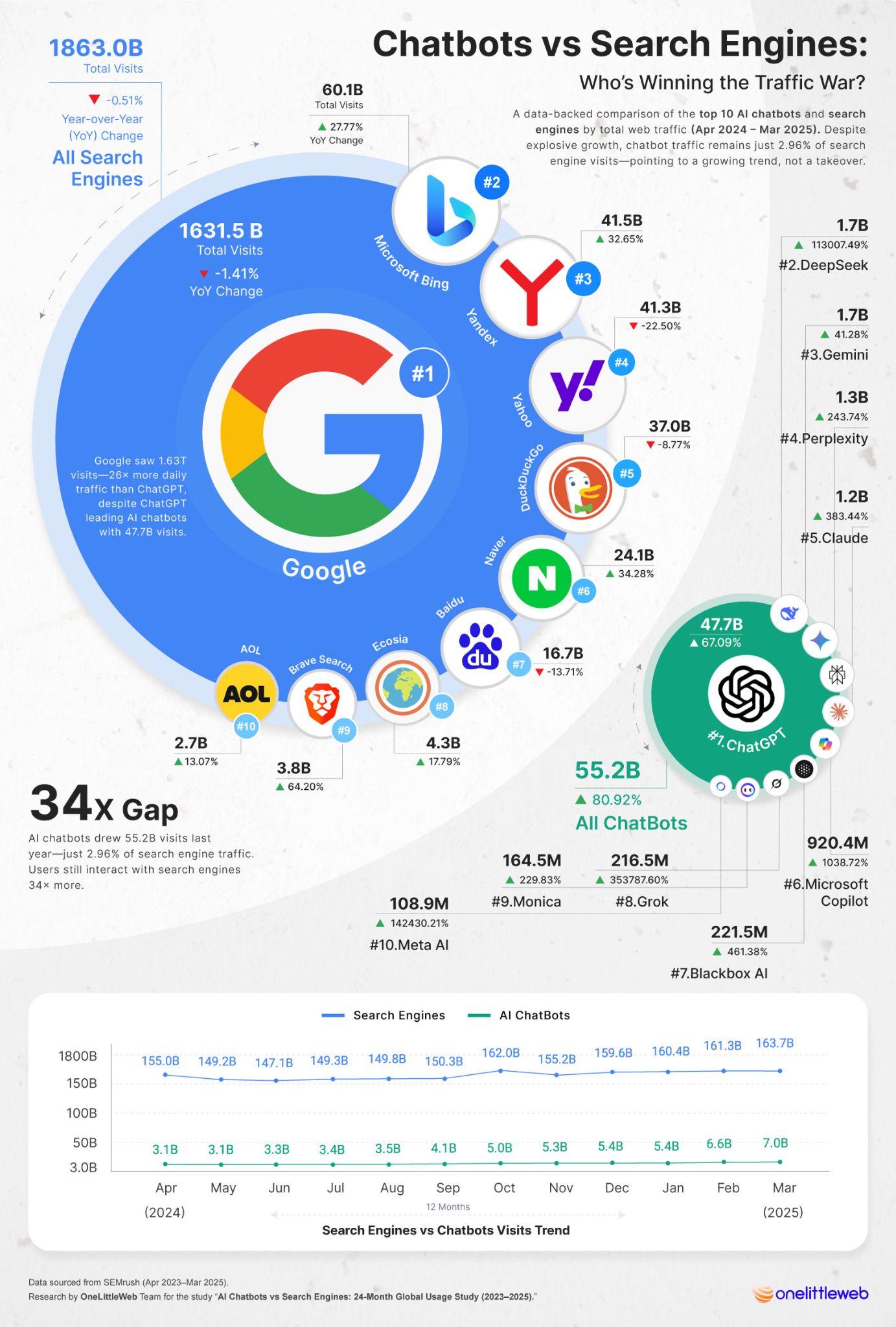
In March 2025, search engines averaged 5.5 billion visits per day. Meanwhile, AI chatbots “only” reached 233.1 million. The difference is quite large at first glance. Google remains the undisputed giant in the search world, after all. The service from the Mountain View giant boasts a market share of around 90%. Not everything is rosy for Google, though. Its privileged position cost it an unfavorable antitrust ruling that could force it to sell Chrome and other potential remedies.
Other major players in the search engine segment include Microsoft’s Bing, Yahoo Search, Yandex, DuckDuckGo, and Baidu. As for AI chatbots, OpenAI’s ChatGPT is the leader in terms of popularity. However, there are also other strong contenders, such as Microsoft Copilot, Google Gemini, Perplexity, Claude AI, and DeepSeek. Furthermore, let’s not forget that new platforms are emerging very quickly. Who would have imagined last year that an unknown DeepSeek would suddenly emerge and crash NVIDIA stock?
Despite the growth of chatbots, the reality is that traditional search engines are still the primary place we go when we need to find information online.
To What Extent Are We Utilizing Chatbots Versus Search Engines?
As per various reports, numerous individuals have experimented with chatbots at least one time. Specifically, this includes 88% of people based on findings from a Tidio study. Nevertheless, the reality remains that these tools are utilized far less often compared to search engines. By 2023, merely 35% of those who engaged with chatbots opted for them over traditional search engines when seeking information. The majority continue to rely on platforms like Google and associated services for their regular inquiries.

This scenario is quite normal given Google’s deep integration into our daily routines over time. Our smartphones now offer immediate access to all the capabilities of Google. On average, a typical Google user conducts around 200 monthly searches, whereas a Perplexity Search user—powered by artificial intelligence—conducts roughly 15.31 searches each month. Data from Search Engine Land indicates that in 2024, Google handled approximately 373 times as many searches compared to ChatGPT. These figures suggest that even though chatbots like ChatGPT have made progress, they haven’t yet become the primary choice for most individuals seeking information online.
Why Are Search Engines Still Kings?
Even with all the buzz around chatbots, conventional search engines continue to dominate the online information landscape. The reason being?
A key factor behind this is the extensive database of information that search engines like Google have compiled, having crawled trillions of webpages. In contrast, most chatbots typically do not have such vast resources at their disposal. Consequently, you’re likely to discover details on nearly every conceivable topic through a search engine query.
Moreover, we’ve relied on search engines for quite some time now, making us well-versed in their use. Phrases such as “Google it” have become commonplace in everyday conversation. Their user-friendly interfaces continue to contribute to their widespread popularity. However, be cautious because these platforms aren’t lagging behind technologically. For instance, they’re integrating artificial intelligence functionalities—like Google’s “AI Overviews”—which provide quicker, more precise responses. Google aims to merge both traditional searching methods and advanced technology to enhance usability further. This is evident from the advancements seen in Search’s AI Mode.
A key aspect is that search engines provide results drawn from numerous distinct sources. This enables us to contrast data points and determine which facts to accept. In contrast, chatbots may lack transparency regarding their source material or might fabricate details—an issue known as “AI hallucination.” Moreover, for extensive investigations of complex subjects requiring consultation with multiple references, search engines outperform chatbots. Whereas a chatbot offers just one response, a search engine presents various avenues for exploration.
Finally, search engines’ ad-based business model is well-established and allows them to continue investing in improving their technology. Chatbots are still figuring out how to become profitable. OpenAI claims to be losing money even with subscribers to the $200-per-month ChatGPT Pro plan.
To put it briefly, the vast quantity of data that search engines manage along with their continuous advancement through AI technology currently provides them with a significant edge over chatbots.
Where Is Our Future Headed?
What should we anticipate then? Likely, search engines along with AI chatbots will persist and get even more intertwined. These search platforms will keep leveraging artificial intelligence to provide improved responses, whereas chatbots will grow savvier and more dependable. In all likelihood, we might begin employing chatbots for swift, targeted inquiries, yet still rely on search engines for comprehensive investigations.
The markets for these two technologies will keep expanding, with AI potentially driving up overall demand for information. Businesses must grasp the functioning of both search engines and chatbots to effectively connect with their clientele. While SEO remains crucial, it’s essential to also contemplate how chatbots retrieve and utilize data.
In the end, the future will probably merge both realms, enabling conventional search methods and conversational AI to support one another in helping us obtain the necessary information with ease and efficiency.
The post
Artificial Intelligence Has Just Launched an Attack on Google Search
appeared first on
Android Headlines
.