Curious Kids
is a series for children of all ages. If you have a question you’d like an expert to answer, send it to
CuriousKidsUS@Vmeetsolutions
.
How do atoms form? – Joshua, age 7, Shoreview, Minnesota
Richard Feynman
, a famous theoretical physicist who won the Nobel Prize,
said that
if he could pass on only one piece of scientific information to future generations, it would be that all things are made of atoms.
Understanding how atoms form is a fundamental and important question, since they make up everything with mass.
The question of where atoms comes from requires a lot of physics to be answered completely – and even then,
physicists like me
only have good guesses to explain how some atoms are formed.
What is an atom?
An atom
consists of a heavy center, called the nucleus, made of particles called protons and neutrons. An atom has
lighter particles called electrons
that you can think of as orbiting around the nucleus.
The electrons each carry one unit of negative charge,
the protons
each carry one unit of positive charge, and
the neutrons
have no charge. An atom has the same number of protons as electrons, so it is neutral − it has no overall charge.
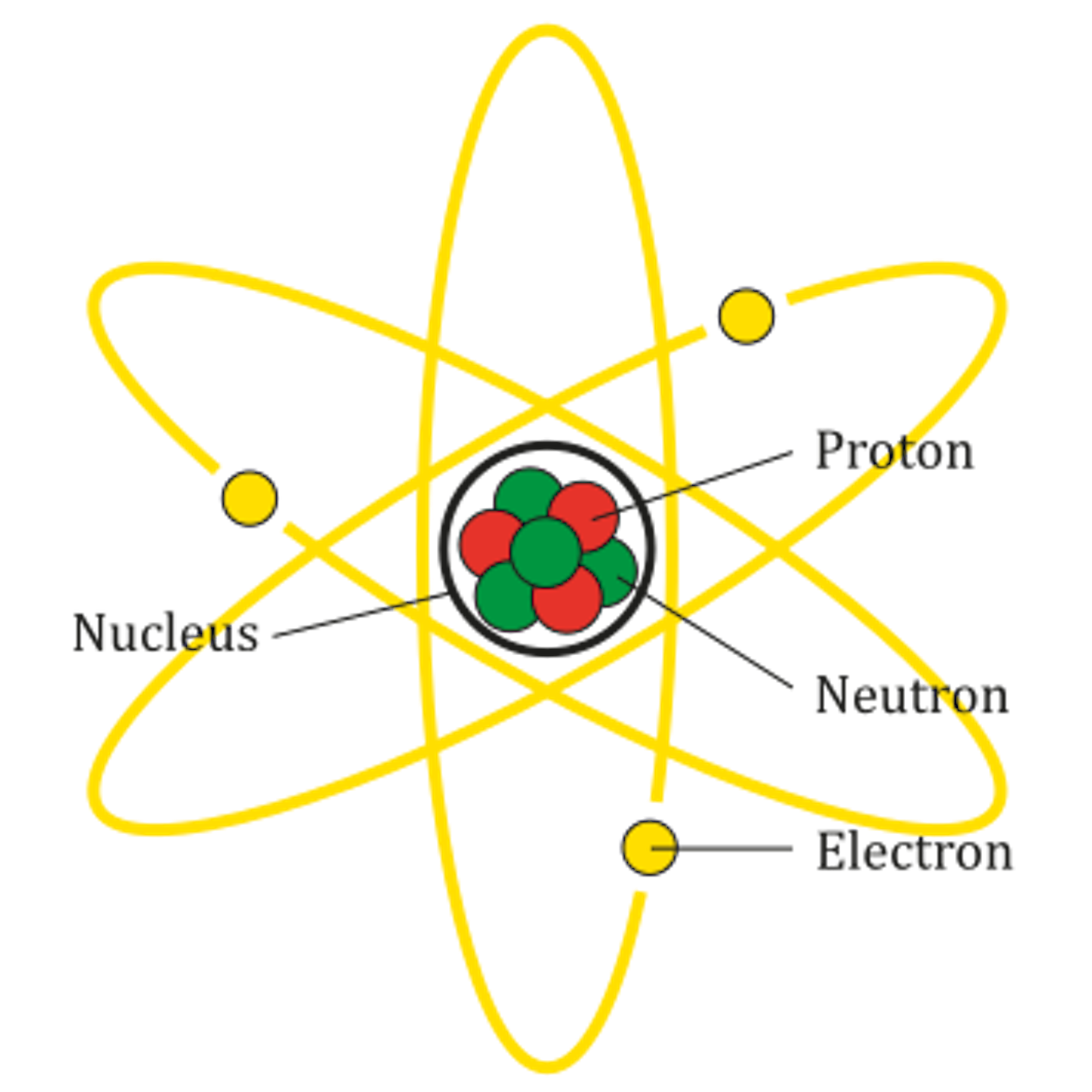
Now, most of the
atoms in the universe
are the two simplest kinds: hydrogen, which has one proton, zero neutrons and one electron; and helium, which has two protons, two neutrons and two electrons. Of course, on Earth there are lots of atoms besides these that are just as common, such as carbon and oxygen, but I’ll talk about those soon.
An element is what scientists call a group of atoms that are all the same, because they all have the same number of protons.
When did the first atoms form?
Most of the universe’s hydrogen and helium atoms formed around 400,000 years after
the Big Bang
, which is the name for when scientists think the universe began, about 14 billion years ago.
Why did they form at that time? Astronomers know from observing
distant exploding stars
that the size of the universe has been
getting bigger
since
the Big Bang
. When the hydrogen and helium atoms first formed, the universe was about
1,000 times smaller
than it is now.
And based on their understanding of physics, scientists believe that the universe was much hotter when it was smaller.
Before this time, the electrons had too much energy to settle into orbits around the hydrogen and helium nuclei. So, the hydrogen and helium atoms could form only once the universe cooled down to something like 5,000 degrees Fahrenheit (2,760 degrees Celsius). For historical reasons,
this process is misleadingly called recombination
− combination would be more descriptive.
The helium and deuterium −
a heavier form of hydrogen
− nuclei formed even earlier, just a few minutes after the Big Bang, when the temperature was above 1 billion F (556 million C). Protons and neutrons can collide and form nuclei like these only at very high temperatures.
Scientists believe that almost all the ordinary matter in the universe is made of about 90% hydrogen atoms and 8% helium atoms.
How do more massive atoms form?
So, the hydrogen and helium atoms formed during recombination, when the cooler temperature allowed electrons to fall into orbits. But you, I and almost everything on Earth is made of many more massive atoms than just hydrogen and helium. How were these atoms made?
The surprising answer is that more
massive atoms are made in stars
. To make atoms with several protons and neutrons stuck together in the nucleus requires the type of high-energy collisions that occur
in very hot places
. The energy needed to form a heavier nucleus needs to be large enough to overcome the repulsive electric force that positive charges, like two protons, feel with each other.
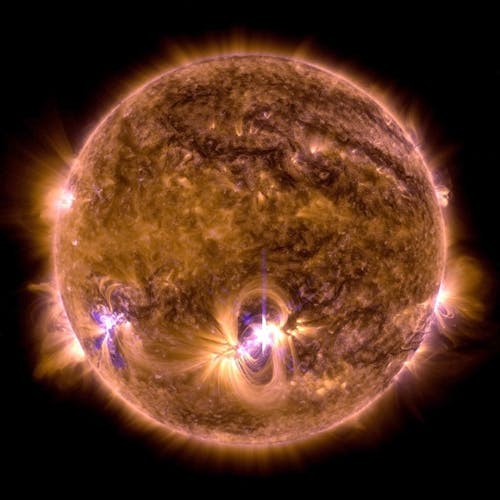
Protons and neutrons also have another property – kind of like a different type of charge – that is strong enough to bind them together once they are able to get very close together. This property is called
the strong force
, and the process that sticks these particles together is called fusion.
Scientists believe that most of the elements from carbon up to iron are
fused in stars
heavier than our Sun, where the temperature can exceed 1 billion F (556 million C) – the same temperature that the universe was when it was just a few minutes old.
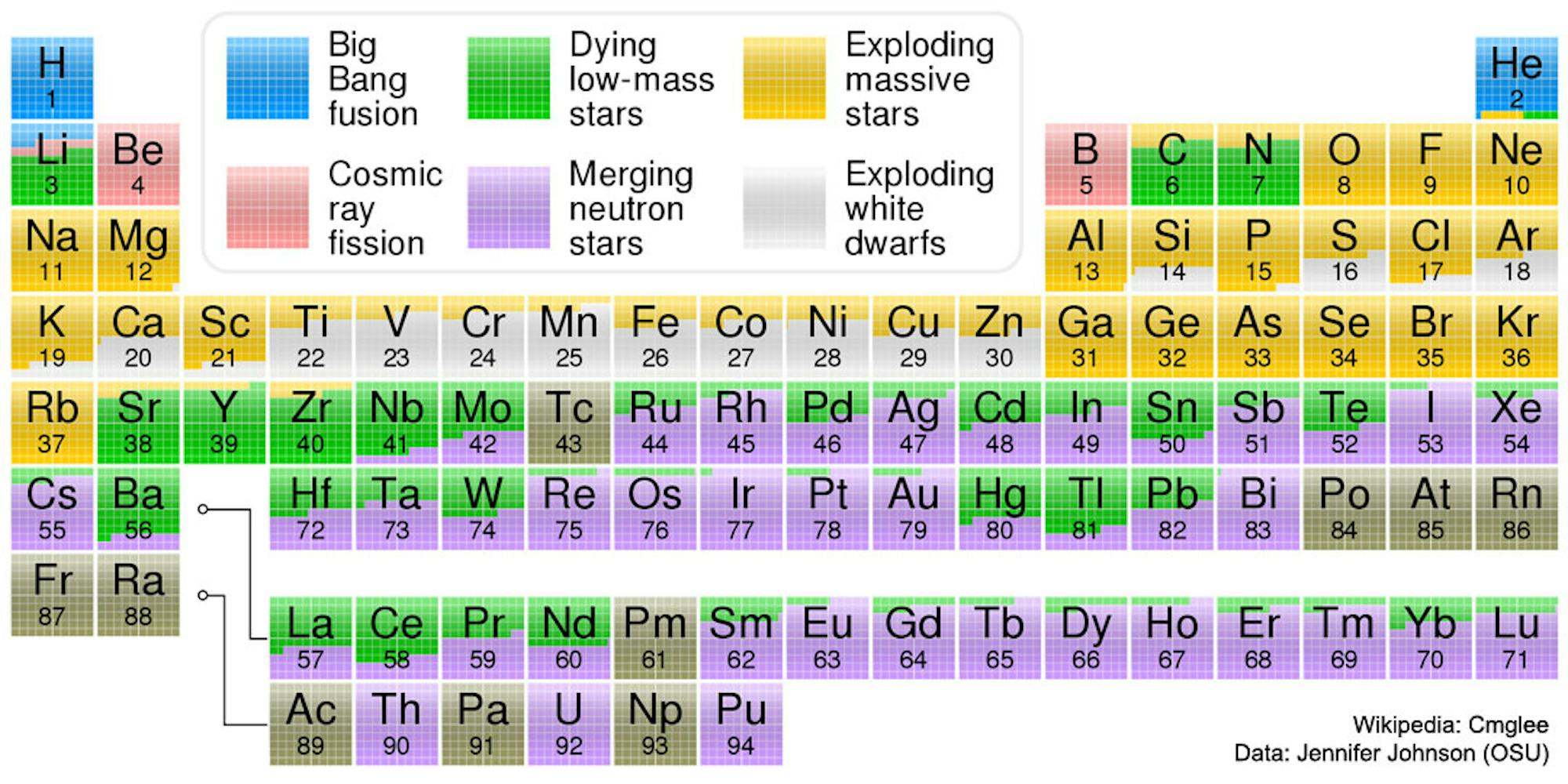
But even in hot stars, elements heavier than iron and nickel won’t form. These require extra energy, because the heavier elements can more easily break into pieces.
In a dramatic event
called a supernova
, the inner core of a heavy star suddenly collapses after it runs out of fuel to burn. During the powerful explosion this collapse triggers, elements that are heavier than iron can form and get ejected out into the universe.
Astronomers are still figuring out the details of other fantastic stellar events that form larger atoms. For example, colliding
neutron stars
can release enormous amounts of energy – and
elements such as gold
– on their way to
forming black holes
.
Understanding how atoms are made just requires learning a little general relativity, plus some nuclear, particle and atomic physics. But to complicate matters, there is other stuff in the universe that doesn’t appear to be made from normal atoms at all, called
dark matter
. Scientists are
investigating what dark matter is
and how it might form.
Hello, curious kids! Do you have a question you’d like an expert to answer? Ask an adult to send your question to
CuriousKidsUS@Vmeetsolutions
. Please tell us your name, age and the city where you live.
And since curiosity has no age limit – adults, let us know what you’re wondering, too. We won’t be able to answer every question, but we will do our best.
This article is republished from
The Conversation
, a nonprofit, independent news organization bringing you facts and trustworthy analysis to help you make sense of our complex world. It was written by:
Stephen L. Levy
,
Binghamton University, State University of New York
Read more:
- What do molecules look like?
- Many stable atoms have ‘magic numbers’ of protons and neutrons − 75 years ago, 2 physicists discovered their special properties
Stephen L. Levy receives funding from the National Science Foundation and the National Institutes of Health. He is affiliated with CyteQuest, Inc.