The Challenge of Creating the World’s Strongest Magnet
The pursuit of the world’s strongest magnet has been fraught with unexpected challenges. In 2012, a team of scientists at the National High Magnetic Field Laboratory’s (MagLab) pulsed field facility at Los Alamos National Laboratory encountered a startling issue: their magnets kept exploding. This was the case when they created the first 100-tesla pulse magnet, named after Nikola Tesla for his 1882 discovery of the rotating magnetic field. A tesla is a unit used to measure the strength of magnetic fields. For reference, the Earth’s magnetic field is only about 50 microteslas — roughly 2 million times weaker than MagLab’s pulsed magnet.
Despite the fact that scientists have produced magnetic fields exceeding 1,000 teslas, these magnets are typically short-lived and explosive. For example, the magnetic pulses in such devices last only 0.0075 milliseconds, making it difficult to collect meaningful scientific data. Similarly, laser-produced magnetic fields, which have reached up to 2,800 teslas, also face similar measurement limitations.
This is where MagLab’s achievement stands out as a significant breakthrough. By developing a non-explosive pulse magnet, the laboratory enables scientists to gather measurable results from experiments involving high magnetic environments. These studies hold immense potential for deepening our understanding of quantum-level behaviors, which can impact energy research, medicine, fundamental physics, and material science.
Applications of High-Magnetic Field Research
One notable application of this technology is in fusion energy research, exemplified by the international consortium ITER, which built a massive 60-foot magnet to study fusion. Another example is MRI machines, which have revolutionized medical imaging. At Los Alamos, MagLab’s 35-ton magnet is driving discoveries across various fields, including quantum technologies and pathology.
The Engineering Behind MagLab’s Mega-Magnet
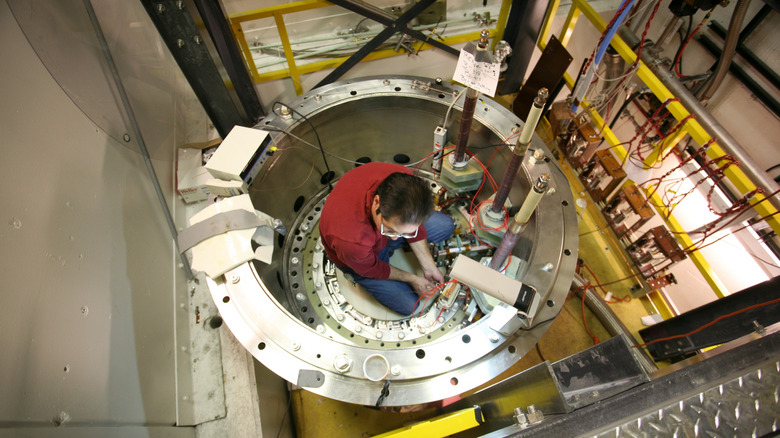
MagLab’s super magnet is an engineering marvel. It consists of four electrical circuits, with an outer coiled magnet containing a smaller inner set. Despite their small bore sizes, the bores within the insert and outsert are approximately 0.59 and 8.9 inches, respectively. The magnetic coils weigh around 9 tons. To generate a powerful magnetic field, MagLab channels an incredible amount of energy through these circuits.
The outer coil uses a 1.4-gigawatt generator — about 200 megawatts more than what Doc Brown needed for his DeLorean. This is equivalent to the energy of 140 million LED lightbulbs. The inner circuit, on the other hand, utilizes a 2-megajoule capacitor, which discharges energy rapidly. To manage heat and resistive losses, the coils are placed inside a dewar field filled with liquid nitrogen. Think of it as a giant stainless steel thermos, keeping the magnet at -324.67 degrees Fahrenheit. Even with this cooling system, the intense energy from each pulse means the magnet takes about an hour to cool down.
How the Pulse Field Facility Works
The Pulse Field Facility is classified as a pulse magnet because its magnetic field lasts only a short time. Each pulse lasts three seconds, but the magnet accelerates from 40 to 100 teslas in just 8 milliseconds — a field it can sustain for 15 milliseconds. While this may seem brief, 15 milliseconds is about two thousand times longer than previous explosive magnets, giving scientists enough time to record usable measurements. Additionally, the facility is a multi-shot magnet, allowing multiple experiments and repeatable results.
Scientific Discoveries at MagLab
Magnets have powered numerous scientific advancements, from magnetic levitation bullet trains to MRI machines. At Los Alamos, condensed matter physicists use MagLab’s magnet to explore superconductivity, examining how particles behave under strong magnetic fields. Scientists compare themselves to astronomers using a telescope to observe otherwise unobservable particles. Through this, researchers study everything from particle behavior to the composition of distant moons.
MagLab scientists test how new materials respond to magnetic forces, which is crucial for developing quantum technologies that make consumer goods and medical devices more efficient. In medicine, the Pulsed Field Facility helps researchers study living organisms and diseases, offering insights into conditions like cancer and neurodegenerative diseases. Their work also aids in identifying the chemical composition of substances.
Recent discoveries include finding water-soluble chemicals in asphalt caused by sunlight, analyzing Arctic rivers, and developing magnetically induced recycling techniques. Astronomers have also used the technology to determine the chemical composition of meteorites and distant moons. Since its 2012 milestone, MagLab has been a leader in American scientific research. However, with a 40% funding cut proposed in Congress’s 2026 budget, the future of the facility remains uncertain, along with the U.S.’s position in magnetic research.