When Nvidia initially presented its latest innovation to us,
GeForce RTX 50-series
graphics cards back at
CES 2025
I was amazed by the frame rates they managed to reach.
Months have passed since then, and having over 200 frames per second in a contemporary game such as Marvel Rivals continues to seem astonishing to me—a humble individual content with consistently achieving 60-plus FPS in my beloved titles.
However, I have remained somewhat doubtful regarding Nvidia’s claims about the capabilities of their RTX 50-series graphics cards. When CEO Jensen Huang stated that the RTX 5070 Ti (with an MSRP of $749) would deliver higher frame rates in contemporary games such as Marvel Rivals compared to the previous model, the RTX 4090 (priced at $1,599), I thought there must be more to consider here.
Certainly, we understand this isn’t the case. The standout performance can largely be attributed to DLSS 4, which represents the most recent iteration of NVIDIA’s graphic enhancement technology. A particular aspect of DLSS 4 contributing significantly to boosting contemporary gaming frame rates is Multi-Frame Generation.
What exactly is DLSS 4?
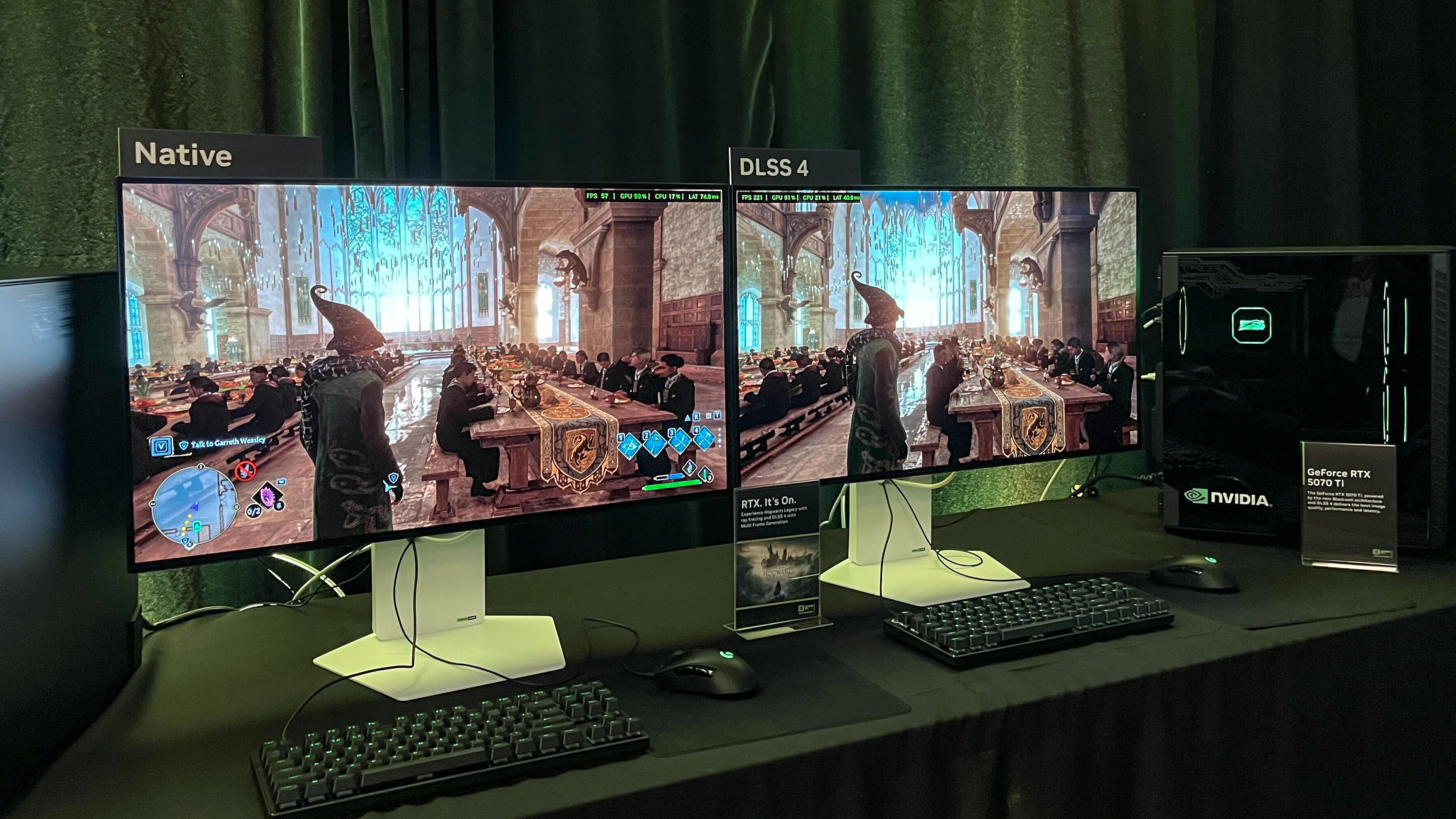
If you’re unfamiliar with it, Nvidia’s DLSS (Deep Learning Super Sampling) technology uses machine learning to render games at lower resolutions and subsequently “upscale” them to your preferred resolution in real-time.
Multi-Frame Generation enhances gaming framerates by producing an extra 1 to 3 virtual frames for each actual frame rendered on screen by your computer.
This technology maintains an apparently smoother gameplay frame rate as it runs with reduced quality settings initially but boosts it significantly just before display.
Since 2019, DLSS has been available, and although newer features can operate on older Nvidia GPU models, Multi-Frame Generation support is exclusive to RTX 50-series graphics cards. This limitation might stem from energy consumption issues, as Multi-Frame Generation enhances gaming frame rates by synthetically producing one to three extra frames for each actual frame rendered on screen by your computer.
Initially, I was quite doubtful upon hearing about this since I wasn’t fond of the notion of having artificially intelligent generated scenes inserted into my gaming experience. In previous instances where I activated DLSS, I encountered issues with graphics glitches, so I assumed things might worsen as my frame rates escalated from two-digit numbers all the way up to three figures.
Moreover, I worried that Multi-Frame Generation might cause games to feel unresponsive or sluggish since a game can only respond to user inputs as quickly as it can produce new frames. So, I thought that if the AI generates even half (or more) of these frames independently from player commands, this could potentially increase lag time.
Certainly, Nvidia’s GPUs also feature Nvidia Reflex. This technology seeks to minimize latency during gaming through various techniques such as synchronizing your CPU and GPU for peak rendering performance and adjusting the timing of when a framed game image is presented based on user inputs right before display.
I got an opportunity to witness these features firsthand earlier this year when
I played games on RTX 50-series graphics cards.
At GDC 2025, I was thoroughly impressed. Contemporary titles like
Avowed
and
Cyberpunk 2077
They perform well on these cards, and during my hands-on experience with games using Multi-Frame Generation, I didn’t encounter significant problems.
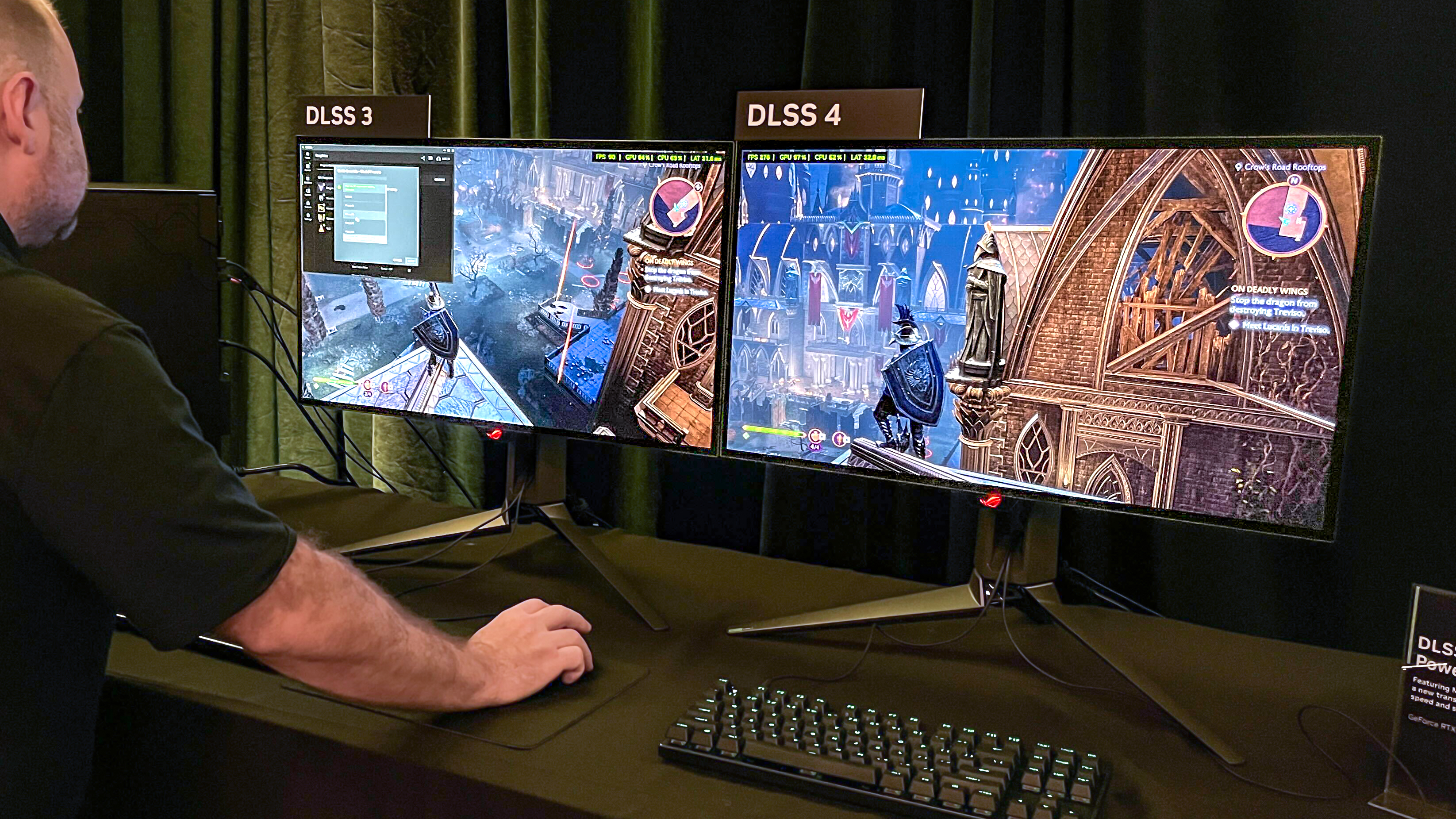
Certainly, this was only a short demonstration, so I couldn’t fully rely on my time at Nvidia’s leased hotel room to accurately reflect what gaming with an RTX 50 series card would be like consistently.
But now I’ve just completed a review of my first RTX 50-series gaming laptop (the
Lenovo Legion Pro 7i
With an RTX 5080 under my belt, I’m diving into a review of the RTX 5090 for gaming PCs, which has granted me several dozen hours of gameplay experience with DLSS 4 and Multi-Frame Generation. To be honest, I was mistaken about some aspects.
Mea culpa

So far, I have dedicated many hours to playing titles such as
Alan Wake 2
, Cyberpunk 2077 and
Star Wars Outlaws
With Multi-Frame Generation activated, I’m really enjoying it.
I’m achieving a consistent 60-90 frames per second in many top-tier PC games played at 4K resolution using my LG C2 OLED TV, even when all visual enhancements are enabled.
Currently, I’m not achieving frame rates in the triple digits, but what I do get is a consistent 60-90 frames per second in certain scenarios.
best PC games
in recent years operating at 4K on my device
LG C2 OLED
With every visual enhancement activated.
So far, I haven’t encountered significant lag problems, possibly due to my focus on less hectic single-player titles instead of quick-reflex multiplayer contests.
I’ve observed some graphical performance hitches when setting Multi-Frame Generation to maximum intensity. You see, numerous titles offering this option let players decide not just whether to activate Multi-Frame Generation but also how extensively they wish it to operate.

For instance, in Alan Wake 2, you have the option to turn off Multi-Frame Generation or adjust it to run at 2x, 3x, or 4x settings. With the least demanding 2x configuration, I experience a substantial increase in frame rate with virtually no drop in graphic fidelity or playability. Even at 3x, the game maintains excellent visuals and performance, though occasionally, minor visual glitches may appear around objects during rapid camera movements.
However, when I turn it up to max at 4x, the numerous frames per second I achieve in Alan Wake 2 become irrelevant since each object in the game is encircled by a fuzzy glow of visual glitches, which intensify as things move around.
What I can’t readily capture with a screenshot is that although the game appears normal when stationary, as soon as you begin moving (causing the frame rate to increase), there’s an unsettling blur surrounding in-game objects that makes me feel somewhat queasy.
There is definitely still some room for enhancement regarding the implementation of DLSS 4 and Multi-Frame Generation. However, this is a small concern considering that my tests have shown it to be a genuine revolution for PC gaming.
More from Tom’s Guide
- I make my living reviewing gaming PCs, and I would absolutely not purchase the RTX 5090 — here’s why.
- Where can you purchase RTX 5090, 5080, and 5070 Ti gaming laptops?
- We put Nvidia’s RTX 5090 desktop GPU through testing — the improvements in gaming performance are enormous.
If you enjoyed this article, click the +Follow button at the top of the page to stay updated with similar stories from MSN.