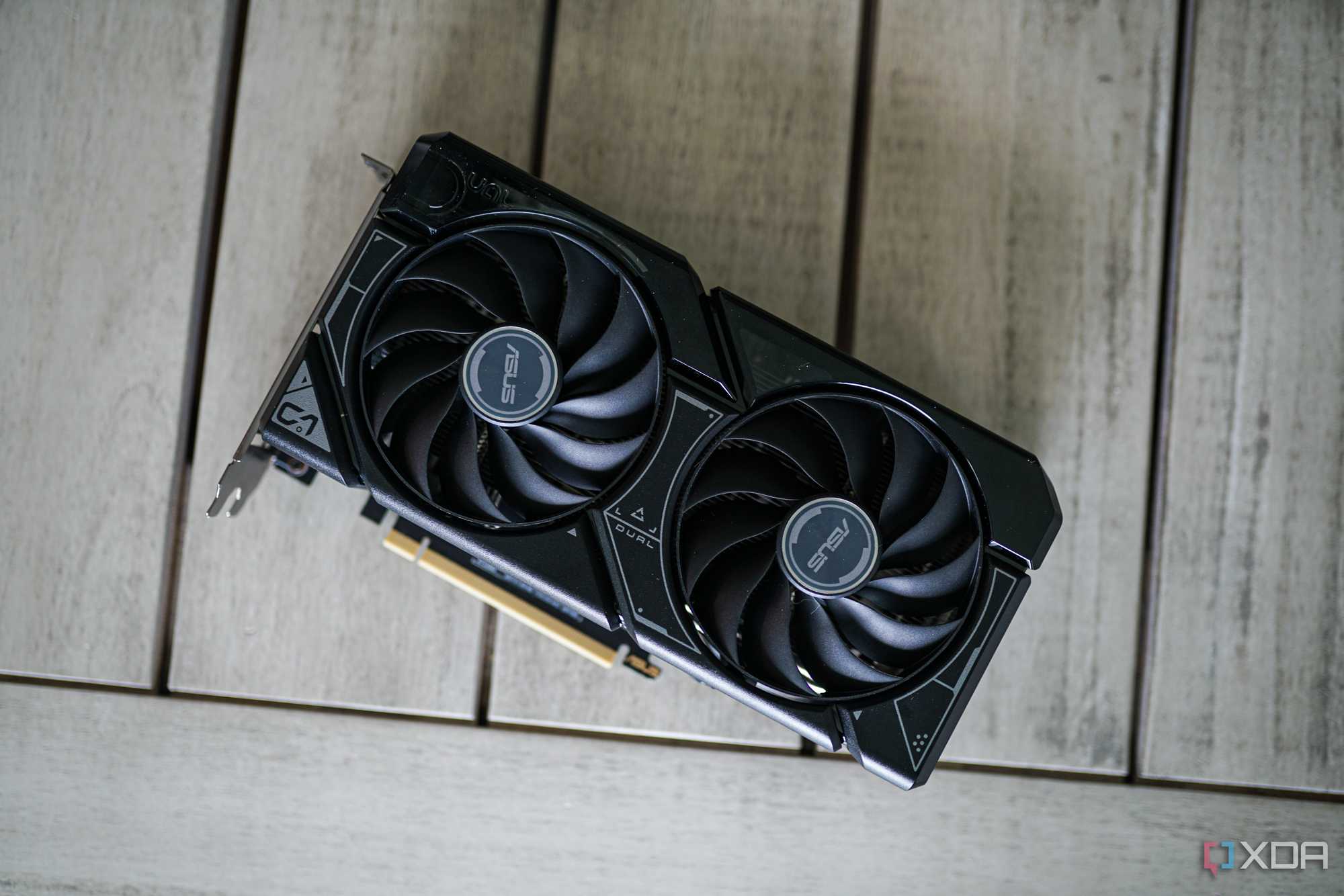
A few weeks ago, an unusual event occurred: the RTX 4060 surged to the pinnacle of the Steam hardware survey, accounting for 8.37% of participants. Although this figure has decreased subsequently, the RTX 4060 continues to oscillate between the first and second positions in Valve’s monthly poll. Despite being at a reduced share, the RTX 4060 still signifies a substantial user base among PC gamers.
nearly a billion estimated PC gamers
Around the world, the RTX 4060 stands for tens of millions of gamers globally.
It’s time to go for a medical examination.
Nearly two years have passed since the RTX 4060 was launched, and when it initially arrived, NVIDIA assured gamers of an exceptional 1080p gaming performance leveraging both robust GPU capabilities and
the ever-present DLSS
The card faced criticism initially, but it has certainly gained popularity within the PC gaming community. After observing its performance in recent titles, I now grasp why it became so popular.
Testing out the capabilities of the RTX 4060
We’ll find out if Nvidia’s assertions stand true.

Graphics card evaluations provide valuable insights into how a new GPU stacks up against competitors, yet these tests often prioritize impartial statistics over actual gaming enjoyment by tweaking various factors. In contrast, my method diverges from this standard practice. Instead of aiming for direct comparisons, I fine-tuned the configurations for every title I assessed to achieve optimal performance levels. Nonetheless, certain conditions were set throughout this evaluation process.
All tasks were executed in full HD resolution. Beyond this, when playing the game, I utilized the maximum graphical settings, and whenever possible, enabled ray tracing. This setup essentially highlights DLSS as the primary factor for enhancing performance. Depending on the game, I adjusted DLSS differently from one title to another, and occasionally employed Frame Generation. My objective was to determine how well these configurations perform in recently launched games running at ultra-high settings under 1080p conditions. Additionally, my testing focused particularly on those parts within each game deemed most resource-intensive—more details will be provided alongside the benchmark data.
In each game, the objective is to reach triple digits. Should the RTX 4060 manage an average frame rate of around triple digits when set to ultra settings at 1080p resolution with DLSS enabled, it’s considered successful. However, achieving more than 60 frames per second would be deemed insufficient for victory. Conversely, falling short of this threshold marks it as a failure. Success earns the graphics card a rating of 10 points; coming up short awards only 5 points; and failing entirely leads to just one point. By averaging these scores across various titles, we’ll determine how well the GPU performs against today’s graphically intensive games.
I’m focusing on actual performance figures here. Should you decide to purchase an RTX 4060 now, these are the kinds of benchmarks you might see. What’s more significant is that most gamers appear to be achieving similar outcomes, according to the statistics available. While there are occasional hiccups, I can comprehend its popularity considering how well it generally performs.
Assessing the Performance of the RTX 4060 in 2025
There’s a great deal of goodness, yet also a fair share of disappointment.
Enough preamble. Let’s get to the benchmarks. Below, you can see the 10 games I tested, all of which were released within the past 12 months on PC. Using the scoring system I outlined, the RTX 4060 earned an average of 7.1 out of 10 points; a C minus, if you assigned it a letter grade. That’s a passing grade, but not an ideal one. However, there are a few specific reasons why the RTX 4060 is knocked down a couple of letter grades.
Let’s deal with
Indiana Jones and the Grand Loop
first. You can play this game with the RTX 4060, and you can get decent performance if you use one of the lower graphics presets with DLSS. However, the game refused to load after I switched to the Ultra preset — that’s two steps below the maximum graphics preset, for what it’s worth — instead throwing up a “failed to allocate video memory” error. This game is notoriously tough on your VRAM, but I don’t suspect most PC gamers to understand how texture streaming works in idTech 7. So, I’m counting this game as a failure.
Warhammer 40K: Space Marine 2
Additionally, it caused a memory error for me when I switched to the Ultra preset at 1080p, even though it was the highest-performing game among those I tested aside from
Path of Exile 2.
Nevertheless, the performance remained solid; there were no hitches, and I didn’t encounter any texture popping problems.
The game in which I faced the most problems was, paradoxically, the one promoted by Nvidia.
Half-Life 2 RTX.
The overall performance looked decent based on the metrics, so I factored this game into my ratings accordingly. However, actually playing it didn’t feel very good. You might have noticed the abysmal 1% low average; whenever significant events occurred on-screen—like an explosion—the gameplay would frequently descend into short bursts of lag and stutters. To achieve what Nvidia advertises as the full 1080p Ultra with ray-tracing for this title and others like it, I enabled path tracing. While it’s feasible to maintain playability using this method, the RTX 4060 definitely faces some trade-offs.
Even though I mostly followed the guidelines mentioned earlier, there were a few instances where I made exceptions.
Final Fantasy VII Rebirth
The game doesn’t offer DLSS quality settings; instead, it employs dynamic resolution scaling, ranging from as low as 50% internal resolution up to 100%. I kept the dynamic resolution within these parameters. To evaluate its performance under stress, I conducted tests in the open-world environment with the most taxing situations—this approach applies to all games I’ve assessed. During my test run, I engaged in combat with a monster.
Monster Hunter Wilds
while testing, and I was being swarmed by trash mobs in
Path of Exile 2.
The other exception is
Black Myth: Wukong.
This game is extremely demanding, even on flagship hardware. Because of that, I used the Very High preset rather than the top Cinematic preset. A few Unreal Engine 5 games, including
Wukong
and
Lords of the Fallen,
Include this cinematic option that leans more towards a “Very Ultra” setting rather than the highest available preset. Since you sacrifice minimal visual quality, it makes sense to opt for this choice during gameplay.
Wukong
This method applies to the RTX 4060.
A satisfactory score for the RTX 4060
However, one major issue still persists.

The performance of the RTX 4060 is robust, delivering an excellent 1080p gaming experience across most modern titles without pushing the limits of graphics tech. You’ll frequently see frame rates reaching three figures outside of cutting-edge releases. Additionally, this card performs admirably in both classic solo adventures and perennial online favorites found at the top of Steam’s rankings. However, the primary drawback of the RTX 4060 lies in its limited video memory capacity.
This isn’t a new criticism. Nvidia has been
roundly critiqued for its lacking VRAM capacity
over the past two generations, showing up most recently with the
RTX 5060 Ti
It’s also relevant for the base RTX 5060 model. Thanks to the potent raw power of the RTX 4060 along with NVIDIA’s enhancing DLSS technology, you can achieve outstanding gaming performance in even the toughest titles, including those requiring full path tracing. However, running low on framebuffer memory presents some challenges.
Stutters in
Half-Life 2 RTX
and compelled to initiate
Indiana Jones and the Grand Loop
When switching to safe mode and lowering the graphics settings to their minimum, the problem becomes evident even with 8GB of VRAM. Despite using just Full HD resolution, it’s apparent that this amount of VRAM might be insufficient. This seems particularly true for NVIDIA aiming to position its mid-range cards as suitable for high-quality 1080p gaming experiences. Using features like DLSS to enhance performance didn’t fully resolve these difficulties; during actual play sessions, problems still arose.
Conventional GPUs require some support.
Mainstream GPUs are not obsolete, and considering the performance that DLSS can provide, they seem to be quite vibrant. The primary challenge lies in the limited 8GB frame buffer. Fortunately, Intel has addressed this problem with their latest solutions.
Arc B580
, both Nvidia and AMD have acknowledged the issue; Nvidia with the release of the 16GB RTX 4060 Ti, and AMD with the introduction of the RX 7600 XT. Now it’s time for them to take action and address this concern properly.